Publications
Peer-reviewed publications, preprints, and theses spanning computational materials science and molecular quantum chemistry. Current work focuses on vacancy–solute coupling and grain-boundary segregation in nuclear alloys using DFT and ML potentials, building on earlier contributions in noncovalent molecular interactions and colorimetric sensing.
2025
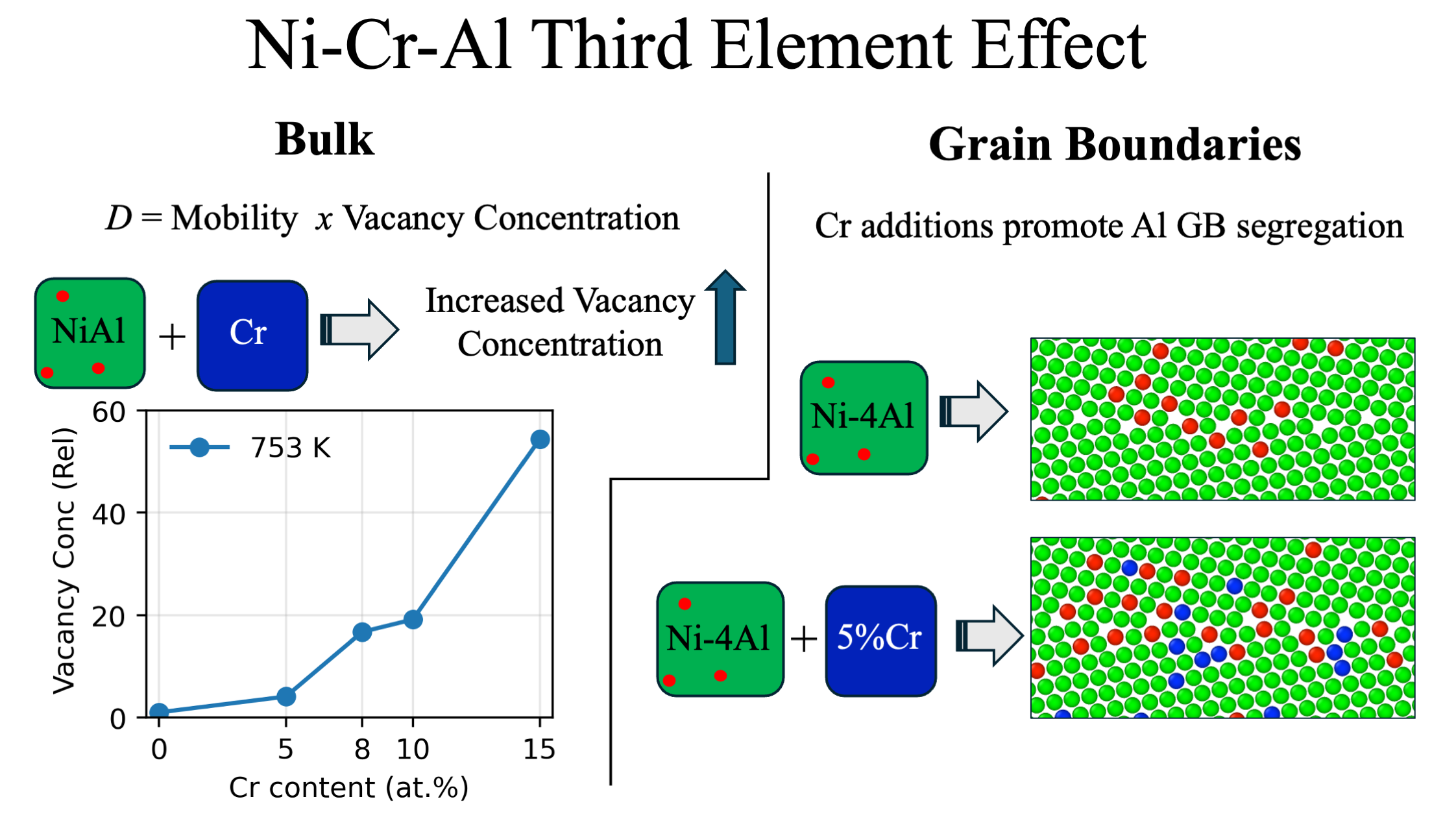
Chromium Raises Vacancy Concentration and Promotes Grain-Boundary Al Segregation in Ni–Cr–Al
Scripta Materialia (submitted; SSRN 5759303)
Preprint
PDF Talk / Presentation Page →2024
C–C Bonding in Molecular Systems via Cross-Coupling-like Reactions Involving Noncovalently Bound Constituent Ions
Molecules 29, 4429
Journal
PDF2023
Modelling of Molecule-Inside-Dipole Complexes: Through- vs. Around-Molecule Ion Transfer
Ontario Tech University (MSc Thesis)
Thesis
PDF2017
Noncovalently Bound Complexes of Polar Molecules: Dipole-Inside-of-Dipole vs. Dipole–Dipole Systems
New Journal of Chemistry 41(22)
Journal
PDF2016
Rational Design of a Material for Rapid Colorimetric Fe²⁺ Detection
Materials and Design 107
Journal
PDF